Building Phoenix’s Next Era
How the city is preparing for a hotter, drier future
Phoenix is experiencing one of the most significant periods of economic expansion in its history and it is no accident. The city has spent decades making disciplined, forward-looking infrastructure investments that position Phoenix to compete globally while delivering real benefits to residents.
Today, as advanced manufacturing reshapes the northern part of the city and major employers invest in our region, Phoenix is building the water, streets and mobility that make this growth possible. We are doing it with the realities of a hotter, drier future in mind, proving that economic competitiveness and climate resilience can advance together.
Phoenix operates one of the largest municipal water systems in the country, serving 1.7 million residents across more than 500 square miles. With more than 7,000 miles of water mains, 5,000 miles of sewer lines and multiple treatment plants, our water infrastructure is the backbone of both daily life and long-term economic development.
For decades, the city planned for drought with a diversified water portfolio that includes groundwater, reclaimed water and surface water supplies from the Colorado, Salt and Verde Rivers. Major investments like the Drought Pipeline Project allow us to move water across the city, ensuring reliability even in the most challenging conditions. We continue to store water underground and expand recharge systems to strengthen long-term supply.
The next major step is Advanced Water Purification (AWP). A regional facility is under construction that will treat recycled water to exceed drinking water standards. This AWP project will create a new drought-resilient supply, increase local control and position Phoenix as a national leader in water innovation. It is the kind of infrastructure that allows advanced manufacturing to grow responsibly.
Despite decades of population growth, Phoenix has reduced per capita water use by roughly one-third. That efficiency, combined with strong policy and public education, is a competitive advantage. Large water users, including advanced manufacturers, must meet strict efficiency and reuse standards to ensure growth aligns with sustainability goals.
Nowhere is the city’s infrastructure investment more visible than in north Phoenix. Growth around the Taiwan Semiconductor Manufacturing Company site reflects a broader transformation. This is not a single project; it is the emergence of a new economic corridor. Its arrival has accelerated development across the region. What is taking shape is a new city that requires the full spectrum of municipal infrastructure.
Supporting rapid development in north Phoenix required major arterial investments. Between 2020 and 2022, Phoenix designed and constructed improvements to 43rd Avenue, 51st Avenue and Dove Valley Road, including four miles of new major arterial roadway with paving, sidewalks, ADA ramps, streetlights and landscaping. Three new traffic signals were added along 43rd Avenue and the city worked closely with the Arizona Department of Transportation on Loop 303 interchanges at 43rd and 51st Avenues.
In total, the city invested $232.5 million in water and street infrastructure to support the area. These improvements are not just about one employer; they are about creating a long-term economic corridor that will support thousands of jobs and new businesses for decades.
Looking ahead, the design phase of the North Valley Parkway Sonoran Bridge Project is underway, with construction anticipated in 2029. This project will further strengthen mobility in one of the fastest-growing parts of the city.
A strong economy requires a strong airport and Phoenix Sky Harbor International Airport continues to deliver. The Phoenix Airport System, which includes Phoenix Sky Harbor and general aviation airports Phoenix Deer Valley and Phoenix Goodyear, is the largest economic engine in the state of Arizona with a $44.3 billion annual impact. Phoenix Sky Harbor plays an important role as an employment center for more than 47,000 people across the metro area.
Phoenix has been building for a hotter, drier future for decades. Cool pavement, reflective materials, energy-efficient facilities and water smart development standards are already embedded in how we design and deliver infrastructure. Sustainability is not a new priority. It is a long-standing principle that guides every investment we make.
Phoenix’s success is rooted in long-term thinking and a commitment to serving the community. The Mayor and City Council have set a clear vision: build infrastructure that supports economic opportunity, protects our valuable resources and enhances the quality of life for every resident. Phoenix continues to deliver on the promise of building a resilient, competitive and sustainable city for the next generation.
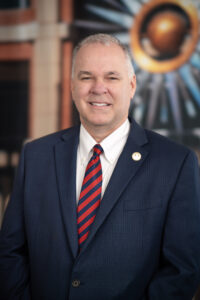 By Ed Zuercher. He is the City Manager for Phoenix, Ariz. He can be reached at ed.zuercher@phoenix.gov
This story is featured in our September/October issue of American Infrastructure. Read it here.