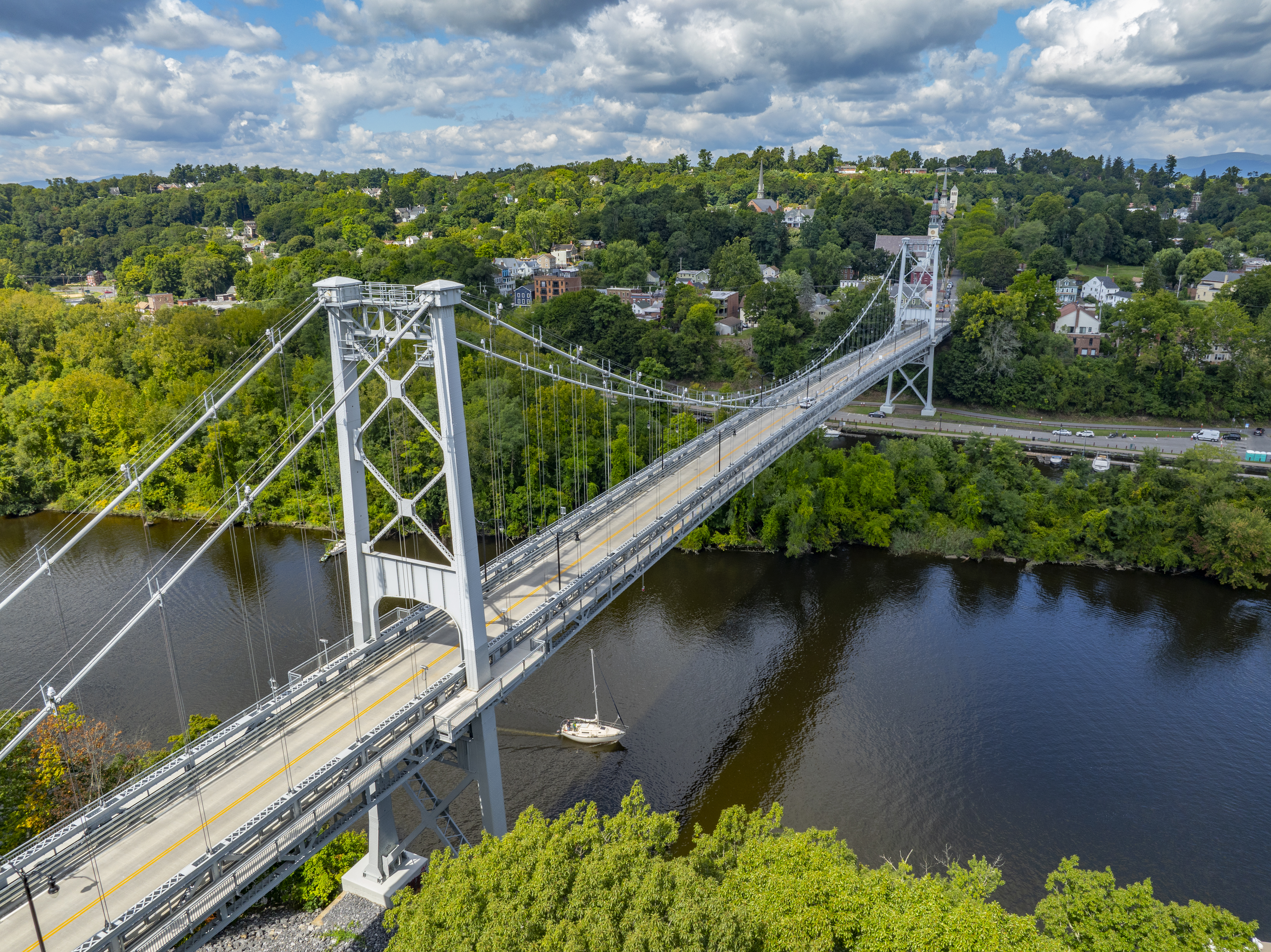
Wurts Street Bridge Rehabilitation
Elegant engineering restores a century old structure
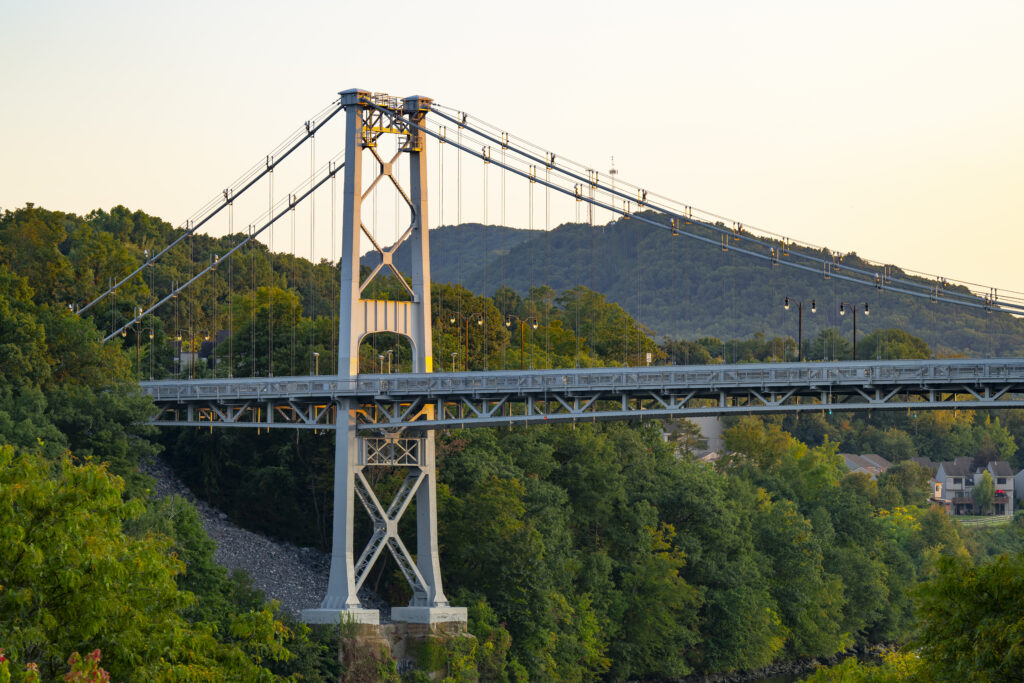
Originally built in 1921, the Kingston-Port Ewen Suspension Bridge also known as the Wurts Street Bridge is a routine route for travel between the City of Kingston and the Hamlet of Port Ewen in New York. The suspension bridge was one of the first of its kind in the Hudson Valley. The project was an engineering marvel of its time with two approaches and its towers resting at different elevations, a vertical difference of 20 feet. By the 21st century, the 103-year-old Wurts Street Suspension Bridge was heavily corroded and damaged. Travelers and pedestrians noticed the effects of chronic exposure, when the bridge was inspected the damage was more structurally critical than visually present.
 Rehabilitation
Bridges with a reduced capacity are inspected every year. An inspection of the bridge from 2007 was not positive however, a source of funding for rehabilitation was not readily available. One local Assemblyman Kevin Cahill was determined to secure funding for the valued structure. In 2017, through state funding and federal grants, funding was awarded to the rehabilitation of the Wurts Street Bridge.
The resilience of suspension bridges heavily relies on the condition of its cables. By 2017, engineering firm Modjeski and Masters found that the bridge in some cases had up to 50% section loss. As New York State Department of Transportation’s only wholly owned suspension bridge, the solution to the complex deterioration could not be produced immediately. Through close collaboration between Modjeski and Masters and NYS DOT the restoration process was on track.
Blaise Blabac, Project Manager, Vice President and New York Assistant Regional Director at Modjeski and Masters worked on this bridge since 2007. Through careful calculation the suspenders were susceptible to critical section losses. The suspenders are what are attached and hold up the deck a to the main cable and support the structure. Connecting the suspenders to the stiffening truss in tight confines are anchorage eye-bars. Over time they had been painted over and went uninspected because they were secluded. They were corroded by water exposure and a lack of cleaning. When evaluated properly, they were identified as critical members and the bridge closed in 2020.
Modjeski and Masters’ response was elegantly engineered. They developed a supplemental anchorage system to partially offload the eye-bars and redirect the capacity of that system with new rock anchors. Due to the sensitivity of the operation, the engineering team was on site with instrumentation as they were transferring load out of these eye bars into the rock anchors. This solution was not initially taken into consideration during the design stage, this system gave them confidence that it would work. The engineering team worked with strain gauges in real time giving them data on the stress transfer out of the eye bars into the rock anchors. “We don’t do this work every day, but we have confidence in our solution,” said Blabac. “It worked exactly as we had planned.”
Completion
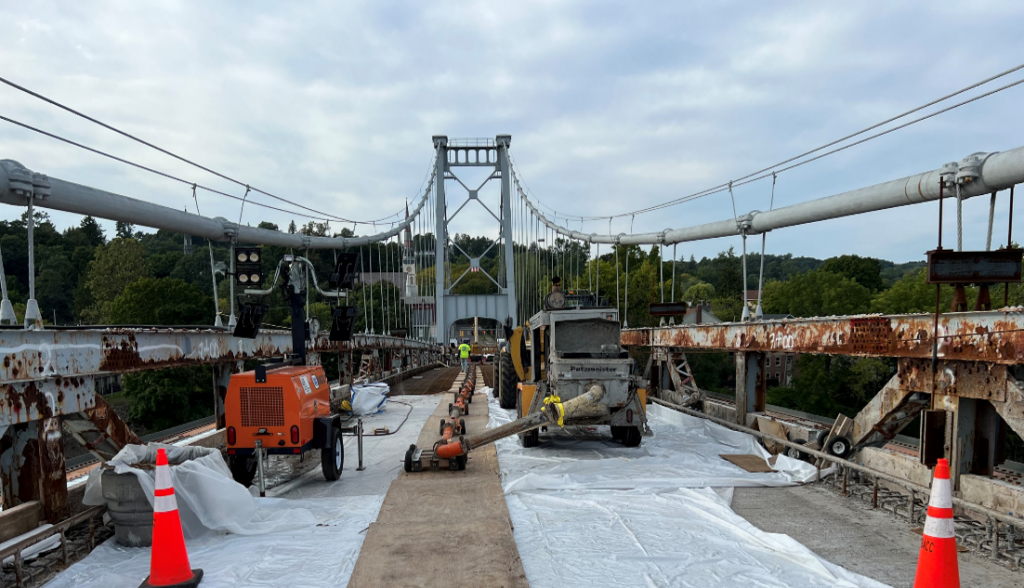
Under a $60 million budget, in 2024 the Wurts Street Bridge opened to the public for transportation. The full rehabilitation required replacements of the structure’s deck, roadway barrier, stringers, expansion joint and the suspender ropes. The team also strengthened the floorbeams and main cable anchorages.
As well as a dehumidification system installed in the anchorage chambers. With a total project length of 1,145 feet, 705 of that encompassing the main span, the landmark was successfully given a longer life. More importantly, the safety of infrastructure was secured.
Awards
In 2025, the bridge was awarded by the American Association of State Highway and Transportation Officials’ (AASHTO) in their America’s Transportation Awards. The project was honored in the “Quality of Life/Community Development, Medium Project” category. “Restoring the historic Wurts Street Bridge was a labor of love for our team at New York State DOT as we worked to connect the communities that benefit from this important travel route with an updated structure that preserves its grandeur for future generations,” said NYS DOT Commissioner Marie Therese Dominguez in a press release.
The project’s recognition was an acknowledgement of the hard work and dedication of structural engineers for the greater good of the community. “We do it for the value in the engineering work that we do, that’s the appreciation that we have for making sure a structure like this is still in use,” said Blabac. Modjeski and Masters’ also designed rehabilitation options and life cycle costs for maintaining the bridge, ensuring that it will remain safe and usable on a regular basis. The Wurts Street Bridge now safely transports up to 54,000 vehicles per day.
Photo Credit(s): Modjeski and Masters
By Sofia Feeney. Sofia is the Editor of American Infrastructure and can be reached at sofia@builder.media.
This story is featured in our January issue of American Infrastructure, read the print version here.